

How to Plan the Perfect City Break in 24 Hours
A 24-hour city break works best when you pick direct flights, focus on 3-5 key experiences, and plan efficient logistics.
By Martin Zokov
• 12 min read
Want to plan a quick city getaway in just 24 hours? Here’s how to make it happen:
- Pick a destination with direct flights: Use tools like Google Flights or Skyscanner to find affordable, easy-to-reach options. Aim for a morning arrival to maximize your time.
- Focus on 3–5 key experiences: Choose attractions or activities that matter most to you, avoiding the stress of overpacking your day.
- Plan transportation and lodging: Stay near major attractions and use public transit or walking to save time and money.
- Use tools like Funizy: Quickly create a personalized itinerary tailored to your interests for as little as $5.
- Keep it simple and flexible: Stick to your plan, but leave room for spontaneous discoveries.
This approach ensures you make the most of your trip without overthinking or overspending. Ready to dive into the details? Let’s go!
THE ULTIMATE TRIP PLANNING GUIDE 📓 4 Steps to a Perfect Itinerary [FREE PDF]
sbb-itb-27c3d16
Step 1: Choose Your Destination
Pick a city with direct flight access to make the most of your 24-hour trip. Start by narrowing down destinations based on direct flights available from your nearest airport. Tools like Google Flights Explore or Skyscanner's "Everywhere" search can help you quickly find affordable, direct-flight options. Sue Cockell, Founder of Sue Where Why What, highlights the benefit of this approach:
"What I especially love is the option to choose to fly 'Everywhere'. It gives you a list of destinations & prices that are available from your starting point & can be a great source of inspiration."
Once you've decided on a destination, focus on travel logistics to ensure every moment of your trip is well spent.
Check Travel Time and Ease of Access
Plan for a morning arrival - ideally around 10:00 AM - to maximize your time. Opt for direct or single-stop flights to avoid delays and give yourself more time to explore. Make sure you have a clear plan for getting to the city center quickly using reliable local transportation.
Rome2rio is a great resource for mapping out routes, covering over 200,000 train lines, 700,000 bus routes, 12,000 ferries, and 50,000 flight paths worldwide. If you're traveling within the U.S., Wanderu can help you compare options like Amtrak, FlixBus, and Greyhound for ground transportation.
Compare Costs in USD
Think beyond the initial airfare when budgeting. Factor in baggage fees, airport transfers, and lodging to get a complete picture of your trip's cost. Keep in mind that budget airlines often charge extra for things like checked luggage, seat selection, and even printing boarding passes at the airport.
Cody Candee, CEO and Founder at Bounce, notes:
"In this day and age, you can often find amazing deals on flights to European countries from the UK, for not much more than a train from, say, Manchester to London."
For U.S. travelers, short-haul flights can sometimes be cheaper than long drives. For example, Istanbul offers three-star hotels averaging $72 per night, while in Paris, you can enjoy a classic steak-frites meal for under $13 at a bouillon-style restaurant. When searching for hotels, filter for guest ratings of 8.0+ and free cancellation to keep your plans flexible without compromising on quality.
Balancing cost and convenience is key to fine-tuning your itinerary for the perfect 24-hour getaway.
Step 2: Decide What Matters Most to You
Now that you’ve picked your destination, it’s time to focus on the heart of your city break: the experiences that will make it memorable. This step ties in perfectly with the streamlined logistics you worked out in Step 1.
Trying to see everything in a short trip is a recipe for burnout. Instead, focus on 3–5 key attractions that align with your interests. Whether it’s a famous landmark, a lively food market, a breathtaking viewpoint, or an immersive local experience, narrowing your focus ensures quality over quantity. Charlie Gaffney from World Locals puts it perfectly:
"Three to five 'anchors' give your day structure without overwhelming it. Everything else you discover along the way becomes a bonus rather than a source of pressure."
Pick Your Top 3 Attractions
Start by identifying what kind of traveler you are. If art is your passion, choose one museum that suits your taste - like a collection focused on Impressionism - rather than trying to rush through multiple galleries. Food enthusiasts? Shortlist a couple of dining spots near your main attractions to save time and energy. As Eleanor Aldridge, a travel writer, points out:
"If you dash from museum to gallery to brasserie, you'll see little more than the well-trodden tourist trail... Our 48-hour itinerary includes plenty of the big-hitters, but also some more niche museums."
For up-to-date recommendations, platforms like TikTok or Reddit can be goldmines. Check recent reviews to confirm venues are open and avoid surprises like closures or renovations. Also, take note of opening hours and the last available transport to avoid mishaps like showing up to a closed attraction or missing your way back.
Once you’ve nailed down your must-see spots, the next step is organizing them efficiently.
Use Funizy for Custom Planning
After choosing your top attractions, Funizy can help you plan your day without the hassle. This platform creates personalized travel itineraries based on your preferences - whether that’s walking tours, dining, shopping, or sightseeing. Covering cities worldwide, it lets you map out your day starting from any point you choose, ensuring your plan revolves around what you care about most.
For a quick 24-hour trip, Funizy can save you hours of research by building a tailored itinerary in minutes. Plans start at just $5 for 10 tokens, giving you an affordable way to simplify your travel planning without juggling multiple sources.
Step 3: Create a Practical Schedule
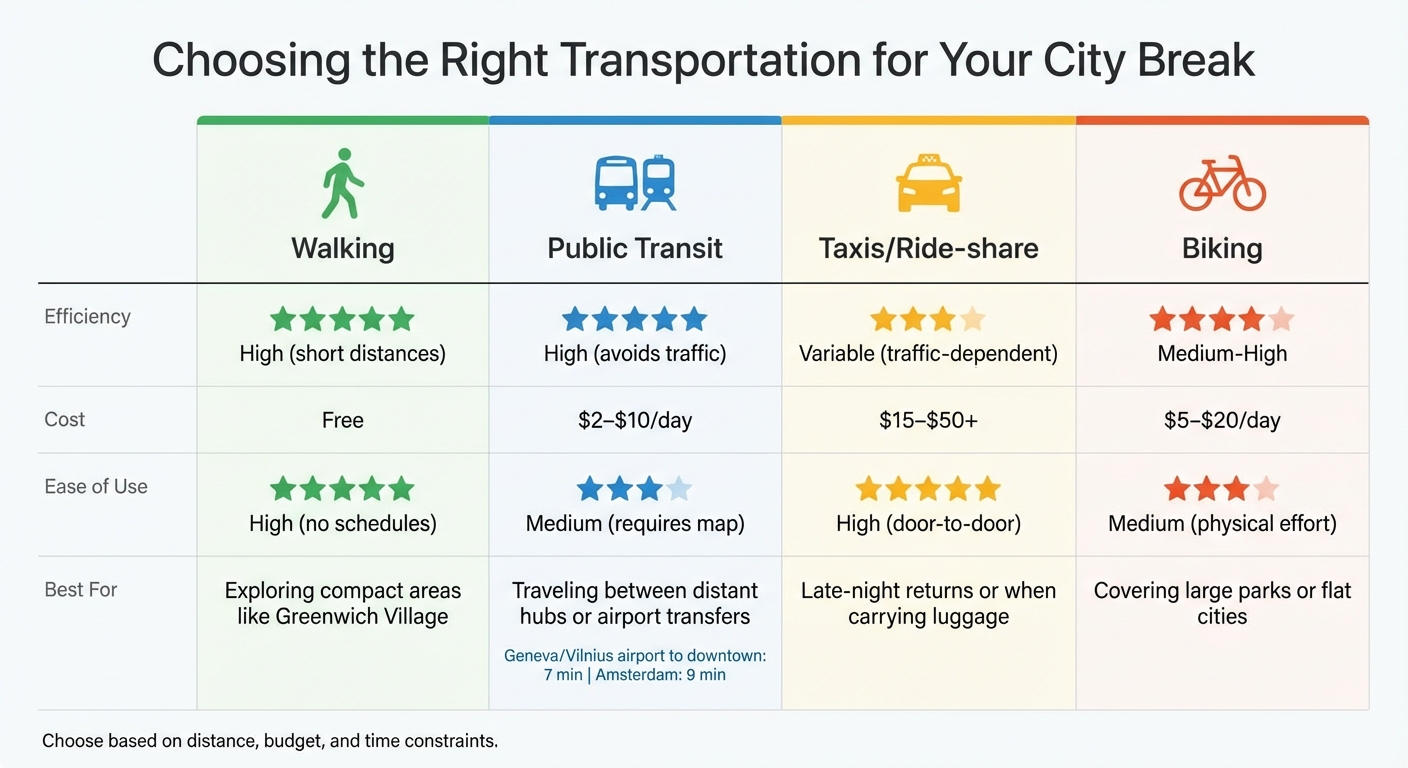
City Transportation Options Comparison: Cost, Efficiency and Best Use Cases
Once you've pinpointed the attractions you want to visit (from Step 2), it's time to map out a schedule that keeps you on track without wearing you out. The trick is to break your day into manageable chunks and plan how you'll navigate between stops.
Split Your Day into Morning, Afternoon, and Evening
Dividing your day into three parts gives you structure while leaving room for flexibility. Start your morning (7:00 AM–11:00 AM) with a visit to a major landmark. Early hours mean fewer crowds and great lighting for photos. Use the midday block (12:00 PM–4:00 PM) for indoor activities like museums or exploring quieter neighborhoods - perfect for when you need a slower pace. Evenings (5:00 PM–9:00 PM) are ideal for a relaxed dinner, a scenic river cruise, or enjoying live music at a local spot.
Maximizing your time is all about efficiency. For example, grab a quick bite from a food truck or street vendor instead of sitting down for lunch, saving 30–45 minutes for another activity. If your arrival or departure times don't align with hotel check-in/out, luggage storage services can be a lifesaver. As Cody Candee, CEO and Founder of Bounce, advises:
"To really maximise your short time in a different country and city, you should really consider doing some rather in depth planning prior to your trip. If you decide where you'd like to visit in your chosen destination, pick out maybe three 'must-see' places within reasonable distance of each other to maximise efficiency."
Pre-booking tickets, reservations, or rentals can save you from wasting time in lines. And don’t forget to check the last train or bus schedule to avoid being stranded late at night.
Once your day is structured, the next step is to plan how you'll move between attractions efficiently.
Compare Getting Around Options
Choosing the right transportation can make or break your schedule. The key is finding the balance between speed, cost, and convenience. Here's a quick breakdown of the main options for city travel:
| Transport Option | Efficiency | Cost | Ease of Use | Best For |
|---|---|---|---|---|
| Walking | High (short distances) | Free | High (no schedules) | Exploring compact areas like Greenwich Village |
| Public Transit | High (avoids traffic) | $2–$10/day | Medium (requires map) | Traveling between distant hubs or airport transfers |
| Taxis/Ride-share | Variable (traffic-dependent) | $15–$50+ | High (door-to-door) | Late-night returns or when carrying luggage |
| Biking | Medium-High | $5–$20/day | Medium (physical effort) | Covering large parks or flat cities |
Public transit often offers the best mix of speed and affordability. For instance, you can get from the airport to downtown Geneva or Vilnius in just 7 minutes, and Amsterdam takes only 9 minutes. Many cities now let you use contactless cards directly on buses or trains, skipping the need for ticket machines. To stay organized, download offline maps and take screenshots of train schedules.
In areas with attractions spread out over a wider area, renting a bike can help you cover more ground than walking, without the unpredictability of traffic. Save taxis or rideshares for late nights or when you're short on time, but keep in mind that they can be pricey, especially during peak hours.
A well-planned schedule and reliable transport ensure you make the most of your city break, turning every moment into an opportunity to explore.
Step 4: Handle Logistics and Get Your Tools Ready
Locking in your travel arrangements - like accommodation, navigation tools, and guides - can make a huge difference when it comes to enjoying your 24-hour city adventure. Taking care of these details upfront means fewer headaches and more time to explore.
Book a Hotel Near Main Attractions
For a short trip, location is everything. Staying close to major attractions or public transit hubs can save you precious time. As Charlie Gaffney from World Locals puts it:
"Choosing a cheap hotel far outside the city (you'll spend more time commuting than exploring)".
If you're heading to Paris, for instance, Deryn, Founder of Inside the Upgrade, suggests:
"Look for places in the 1st through 10th arrondissements if you want easy access to the major sites and a walkable experience".
When booking, aim for hotels with guest ratings of 8.0 or higher and recent positive reviews. Use tools like Google Street View to verify claims about proximity - phrases like "near the beach" or "central" can sometimes be misleading. Check for practical amenities like luggage storage, air conditioning, and free cancellation policies, and always read the fine print to avoid hidden charges.
Use Technology for Maps and Updates
Offline maps are a lifesaver when you're navigating a new city. Apps like Google Maps or Maps.me let you save locations and access them without using data. It’s also smart to screenshot train timetables and save all your reservation emails for easy offline reference.
Review Funizy's Pricing Plans
Funizy offers a token-based system for personalized travel plans, making it easy to customize your itinerary. For a quick city trip, their 10-token package is often ideal, giving you just enough flexibility.
| Plan Name | Price (USD) | Best For | Features |
|---|---|---|---|
| 10 Tokens | $5 | Long weekend trip | Personalized travel plans, pay once and access forever |
| 50 Tokens | $10 | Frequent travelers | Personalized travel plans, pay once and access forever |
| 100 Tokens | $15 | Avid travelers | Personalized travel plans, pay once and access forever |
For a 24-hour city break, the 10-token plan is usually more than enough. But if you're planning multiple trips, the 50-token package offers better value.
Step 5: Follow Your Plan During the Trip
You’ve put in the prep work - now it’s time to enjoy your city break. The trick? Treat your itinerary as a flexible guide, not a rigid to-do list. As Charlie Gaffney from World Locals explains:
"Planning a trip in under 24 hours isn't about rushing. It's about embracing a different rhythm of travel - one that's instinctive, freeing and refreshingly simple".
Start Early and Stay Flexible
Kick off your day around 7:00 AM to make the most of the daylight and give yourself some wiggle room for unexpected delays. Before heading out, check the weather and local updates - plans might need tweaking. For instance, an outdoor market may be closed, or rain might call for switching a park visit to a museum.
Stick to your 3–5 key experiences as the backbone of your day, but be ready to adjust their order or timing based on what unfolds. Also, double-check the timing for the last train or bus back to your accommodation - getting stranded can quickly throw off your plans. Staying adaptable ensures you can move smoothly between planned highlights and spontaneous discoveries.
Keep a Comfortable Pace
Think of your 24-hour itinerary as a collection of memorable moments with breathing room, not a marathon to check off every attraction. Between your main stops, carve out time for simple joys - like sipping coffee at a cozy cafe or relaxing on a park bench for 20 minutes. These pauses let you soak in the city’s vibe and recharge.
If your day includes bustling areas like downtown hubs, balance them with quieter spots to maintain your energy. This balance helps you stay refreshed and enjoy the experience without feeling overwhelmed. And remember, anything you stumble upon beyond your main plan is a bonus - not something to stress over missing.
Conclusion
A successful 24-hour city break is all about keeping things simple and focused. The trick lies in smart prioritization and seamless logistics. Choose a destination that's easy to reach, then zero in on 3–5 key experiences that genuinely spark your interest. This way, you can enjoy a well-structured trip without the burden of an overpacked schedule.
Here’s the formula: pick a destination that’s accessible, focus on a few meaningful activities, plan your schedule thoughtfully, and use reliable tools to handle logistics.
As Charlie Gaffney from World Locals puts it:
"When you strip travel back to its essentials - a destination that excites you, a flight that gets you there, a place to sleep and a handful of experiences you genuinely care about - everything starts to feel lighter".
To save time and avoid surprises, book accommodations close to your activities, download offline maps, and keep screenshots of your confirmations handy. These small steps can make a big difference in ensuring your trip runs smoothly.
Funizy makes planning even easier by offering personalized daily travel plans based on your interests - whether you’re into sightseeing, food, or shopping. Starting at just $5 for 10 tokens, Funizy helps you create a custom itinerary without the hassle, so you can fully enjoy your city break.
FAQs
How do I pick the best city for a 24-hour trip?
When planning a quick getaway, pick a city that packs a lot into a small area. Cities known for their walkability, famous landmarks, and lively neighborhoods are ideal. Look for places with reliable transportation and a mix of attractions that let you experience the best in just one day. This way, you can make the most of your 24 hours without feeling rushed.
What if my flight times don’t match hotel check-in or check-out?
If your flight schedule doesn’t sync up with hotel check-in or check-out times, it’s smart to plan ahead. You could book an extra night if you’re arriving early or leaving late, giving you a place to rest or store your belongings. Alternatively, many hotels provide luggage storage services, allowing you to explore the area without dragging your bags around. Some hotels also offer early check-in or late check-out options for an additional fee - just reach out to them in advance to make arrangements. A little preparation can help you avoid unnecessary stress and make the most of your trip.
How can I avoid wasting time on transit during a city break?
To make the most of your city break, pick a place to stay that's close to major attractions or centrally located. This way, you’ll cut down on travel time and have more spots within walking distance. Also, take advantage of local transit apps to map out routes easily and get around efficiently, leaving you with more time to enjoy the sights and experiences rather than spending it on commuting.