

How to Maximise Your Limited Time in a New City
Plan by priority and location, use transit and navigation apps, start early, and limit to 2–3 attractions daily for efficient visits.
By Martin Zokov
• 12 min read
Visiting a new city for just a day or two can feel overwhelming. With so much to see and do, it’s easy to waste time on inefficient planning or long commutes. Here’s how to make the most of your short trip:
- Prioritize Attractions: Focus on 2–3 key spots per day. Categorize them as "must-sees", "nice-to-haves", and "extras."
- Plan by Location: Group nearby activities to save time. Avoid crisscrossing the city unnecessarily.
- Use Tools: Apps like Funizy or Citymapper help create efficient itineraries, map routes, and avoid delays.
- Start Early: Visit popular attractions during off-peak hours to skip crowds.
- Choose Transportation Wisely: Subways for long distances, walking or biking for shorter trips.
- Immerse Locally: Explore neighborhoods, attend events, and dine where locals eat.
With these tips, you can enjoy the highlights and hidden gems of any city without feeling rushed or stressed.
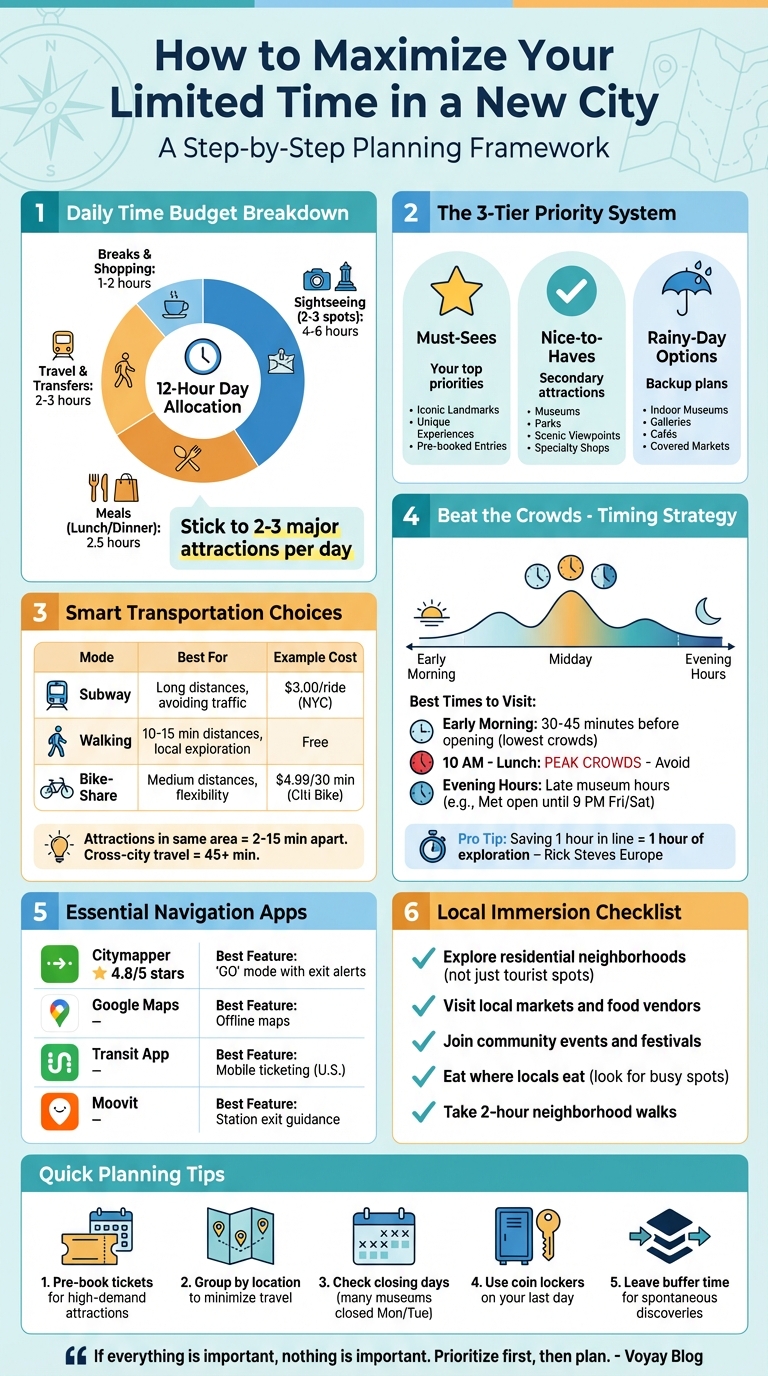
How to Maximize Your Time in a New City: Complete Planning Guide
How to Plan a Trip (maximize time off, beautiful destinations, hotels)
sbb-itb-27c3d16
Plan Your Priorities First
Make the most of your limited time by figuring out which attractions matter most to you. Break them into three categories: "Must-sees", "Nice-to-haves," and "Rainy-day options" to keep your focus on what’s most important.
Choose Your Top Attractions
Keep your daily itinerary manageable by sticking to 2–3 major spots per day. On average, sightseeing takes about 4–6 hours. For example, plan to spend 3–4 hours exploring a major museum like the Louvre, and reserve 1–2 hours for strolling through a nearby neighborhood. Major cities such as Paris, London, or Rome typically require at least 3 full days to cover their iconic landmarks.
Before finalizing your plans, double-check operating schedules. Many European museums close on Mondays or Tuesdays, and seasonal hours can vary. For high-demand attractions like the Colosseum or Eiffel Tower, consider pre-booking timed tickets to skip long security lines and save time.
Group Nearby Activities Together
Arranging your activities by location can save you a lot of time. What looks like a short trip - like traveling between Shibuya and Asakusa in Tokyo - might actually take up to 45 minutes on the subway. Meanwhile, attractions in the same area are often just 2–15 minutes apart. Use a map to pinpoint your must-visit spots and group them logically to avoid unnecessary travel. Spending an entire day in one neighborhood not only cuts down on transit but also lets you stumble upon hidden gems that locals love. This approach keeps your travel efficient while offering a more immersive experience.
Use Funizy to Build Custom Itineraries
Once you've organized attractions by location, take it a step further with a customized itinerary. Funizy creates personalized daily travel plans based on your interests and current location. Unlike generic "top 10" lists, Funizy maps out activities geographically, helping you explore must-see spots within the same area - cutting down on wasted travel time. Whether you're into food tours, scenic viewpoints, or a mix of shopping and sightseeing, Funizy crafts a route tailored to what you care about most.
Get Around the City Efficiently
Once you've mapped out the attractions you want to visit, figuring out how to get around efficiently becomes the next big step. Choosing the right transportation can save you time, money, and the frustration of navigating unfamiliar streets. To make the most of your trip, let’s explore how to use public transit, walking, biking, and navigation apps to streamline your journey.
Learn the Public Transit System
For covering long distances quickly, subways are your best bet - they bypass traffic and get you to your destination faster. In New York City, for instance, a single subway or bus ride costs $3.00. The OMNY contactless system, which fully replaced the MetroCard at the end of 2025, allows you to tap your credit card, phone, or smartwatch at the turnstile. Plus, once you hit $35.00 in fares on one card within a week, all additional rides for that week are free.
"The easiest and quickest way to travel around NYC is by the subway." - NYC Tourism
To save even more time, use express trains - they skip smaller stops and get you to major hubs faster. Local subway stations are typically spaced 8 to 10 blocks apart, so express trains can significantly reduce travel time. Mobile apps with real-time tracking or texting 511123 can help you stay updated on schedules. Another tip: most transit systems allow free transfers between buses and trains within a two-hour window, so plan your connections wisely to stretch your fare.
For shorter distances, though, other options may be just as efficient - or even faster.
Walk or Bike When Possible
When your destination is close, walking or biking can often outpace waiting for a bus or train. Walking also gives you a chance to soak in the local vibe - whether it’s street art, cozy cafes, or quirky shops, you’ll get a better feel for the area. Plus, walking helps you pick up on the subtle boundaries and character of different neighborhoods.
If biking is more your speed, bike-sharing programs like Citi Bike in New York are a great option. A 30-minute ride costs $4.99, making it a budget-friendly way to move around. And if your next stop is just 10 to 15 minutes away, strolling there can be a refreshing way to experience the city’s personality without the hassle of crowded public transit.
Use Navigation Apps
When it comes to navigating urban areas, Citymapper is a standout choice. It integrates subways, buses, ferries, bike-shares, and even e-scooters into a single app. Its "GO" mode provides step-by-step directions, alerts you when it’s time to get off, and even suggests the best train car to board for a quicker exit [13,14,16]. With a 4.8/5-star rating from over 365,000 reviews on Google Play and being named Apple’s "App of the Year" five years in a row, it’s a trusted companion for millions [13,14].
For general navigation, Google Maps is a reliable option. It offers offline map downloads, which can be a lifesaver if you lose your data connection. Meanwhile, the Transit App lets you buy transit tickets directly in certain U.S. cities, adding convenience to your commute [11,16]. Before heading out, download offline maps and use features like Citymapper’s "Main Roads" option to stick to well-lit streets when walking at night. And don’t forget to check for alerts about strikes or service changes that could disrupt your plans.
| App | Best For | Key Feature |
|---|---|---|
| Citymapper | Multimodal Transit | "GO" turn-by-turn & best carriage info |
| Google Maps | General Navigation | Reliable offline maps & street view |
| Transit App | U.S. Commuting | Integrated mobile ticketing |
| Moovit | International Travel | Detailed station exit guidance |
Schedule Activities at the Right Time
Timing plays a huge role in how much you enjoy your city visit. Poor timing can leave you stuck in lines or crowds, wasting valuable time. But with a little planning, you can avoid the rush and make the most of your day.
Visit Popular Places During Quiet Hours
Crowds at major attractions tend to peak between 10:00 AM and lunchtime when tour groups and casual visitors arrive. To beat the rush, aim to get there 30–45 minutes before the official opening . For instance, if you're heading to MoMA, start with "The Starry Night" as soon as the doors open. Similarly, at the Tower of London, head straight to the Jewel House to see the Crown Jewels before the crowds build up.
Evening hours can also be a great option. Many top museums have late-night hours on certain days. For example, The Met stays open until 9:00 PM on Fridays and Saturdays, and the Orsay in Paris keeps its doors open until 9:45 PM on Thursdays. These times are often less crowded and allow you to enjoy more of the experience for your $30 admission at places like MoMA and The Met .
"If you save an hour in line, that's an entire hour of priceless serendipity that you can spend however you like." - Cameron Hewitt, Rick Steves Europe
Also, avoid visiting major attractions on days when others nearby are closed. For example, when the Louvre is shut on Tuesdays, Versailles often becomes overcrowded with redirected visitors. Keep an eye on the weather too - rainy days tend to drive tourists indoors, making museums busier.
Once you've planned your timing, think about how to group activities for efficiency.
Pair Activities That Are Close Together
Sticking to a single neighborhood each day can save you a lot of time. Instead of spending 45 minutes or more traveling between stops, aim for locations that are just 5 to 15 minutes apart . For example, in Tokyo, you can explore Shibuya and Harajuku in one go, walking between Meiji Shrine, Takeshita Street, and Scramble Crossing in just a few minutes.
Limit the day to 2–3 major attractions. Once you factor in 2–3 hours of travel, 2.5 hours for meals, and some downtime, you'll have about 5–6 hours left for sightseeing in a 12-hour day. Planning meals near your next destination and taking breaks along the way keeps your day smooth and avoids unnecessary backtracking.
| Activity Type | Time Budget | Strategy |
|---|---|---|
| Sightseeing (2-3 spots) | 4–6 hours | Group by neighborhood to save time |
| Travel & Transfers | 2–3 hours | Use public transit and navigation apps |
| Meals (Lunch/Dinner) | 2.5 hours | Dine near your next stop |
| Breaks & Shopping | 1–2 hours | Leave space for spontaneous moments |
Finally, plan your last day carefully to make it stress-free.
Make the Most of Your Last Day
Your final day can still be productive with a little backward planning. Start by working from your departure time. For example, if your flight is at 6:00 PM and you need to be at the airport by 3:30 PM, you have until about 2:00 PM to explore after factoring in hotel checkout and travel time. Focus on activities close to your departure point to avoid unnecessary stress.
Use services like coin lockers, hotel bell desks, or luggage delivery to keep your bags out of the way. Pre-book tickets and airport transfers to avoid any last-minute panic . Keep the day simple - choose one or two key activities instead of overloading your schedule. This way, you can turn what might feel like wasted hours into a few last memorable moments in the city.
"If everything is important, nothing is important. Prioritize first, then plan." - Voyay Blog
Experience the Local Culture
Big landmarks may grab your attention, but the soul of a city lies in its local culture. Making the most of limited time isn’t just about checking off famous sights - it’s about immersing yourself in the daily life of the place. From strolling through neighborhoods to attending local events and dining like a resident, these experiences bring you closer to the heart of a destination.
Visit Different Neighborhoods
Tourist hotspots have their charm, but residential neighborhoods offer a more authentic slice of life. Take Ohio City in Cleveland, for example. This area, with its historic Victorian homes and the bustling West Side Market featuring over 100 vendors, provides a deeper connection to the city’s character. In Mexico City, Roma Norte charms visitors with its tree-lined streets and vibrant galleries, while Lisbon’s Alfama district invites you to wander through its narrow alleys, discover cozy Fado houses, and catch serene sunrise views.
Start with a two-hour neighborhood walk to uncover family-run shops, local cafes, and hidden gems. If walking doesn’t cover enough ground, consider renting a bike through programs like Citi Bike in NYC to keep the experience intimate yet efficient. Focusing on one neighborhood per day allows you to soak in the full spectrum of its life - from morning markets bustling with energy to evenings alive with local music. Once you’ve explored the streets, take it a step further by participating in community events.
Join Local Events
Community events strip away the tourist lens and offer a direct connection to the local vibe. Before your trip, subscribe to local newsletters or follow neighborhood-specific creators on social media to stay updated on pop-ups, festivals, or markets. Many events, like guided restoration walks or artisan fairs, are free or budget-friendly. For insider tips, ask service workers - baristas, drivers, or shop clerks often know about weekly happenings. Community centers or churches may also have flyers advertising music nights or seasonal gatherings. These events give you a chance to mingle with locals and experience life as they do. Afterward, turn your attention to the city’s culinary heart.
Eat Where Locals Eat
Forget guidebooks and look for busy spots filled with locals - whether it’s delivery riders grabbing lunch or families sharing a meal. These places often have chalkboard menus or limited English, but that’s part of the charm. In Paris, for instance, neighborhood bistros in areas like the 20th arrondissement offer seasonal dishes in a laid-back setting. A standout is 19 Saint-Roch, where Chef Pierre Touitou serves dishes like braised beef chuck with jute mallow leaves, blending French and Tunisian influences.
For dining tips, ask locals like your barista or a taxi driver, or explore morning markets for fresh produce and regional flavors. Social media can also be a treasure trove - geo-hashtags on Instagram or TikTok can reveal trending spots that locals love. If you’re unsure where to start, a guided food tour early in your trip can introduce you to hidden gems you’ll want to revisit.
"A neighborhood bistro tells a city's story as clearly as a museum - street food reflects daily routines, regional specialties reflect history, and market stalls reveal seasonality." – Flavours.Life
Conclusion
Main Points to Remember
The strategies in this article are designed to help you enjoy both iconic landmarks and local experiences without feeling rushed. To make the most of your limited time, focus on quality over quantity. Stick to visiting just 2–3 attractions each day, as travel and meal breaks usually leave only 5–6 hours for actual sightseeing. Choose attractions that are close to each other to minimize transit time, and start your day early to avoid crowds at popular spots.
While planning is key, it’s equally important to stay flexible. Avoid cramming your schedule - leave room for unexpected discoveries. Consider booking skip-the-line tickets ahead of time, using public transit or bike-sharing services instead of taxis, and categorizing your interests into "must-see", "nice-to-have", and "if there’s time" tiers. This way, you can adjust your plans on the go.
Start Planning with Funizy
Simplify your travel planning with Funizy. Its AI-powered tools create daily itineraries tailored to your preferences and location. Instead of spending hours researching and organizing, Funizy groups nearby attractions, fills small time gaps with relevant activities, and helps you explore like a local - revealing hidden gems that guidebooks often miss.
For just $5, you can get 10 tokens to access custom plans for cities around the world. No need for spreadsheets or multiple apps - Funizy turns even the smallest free moments into opportunities. Make every hour of your trip count - start planning today!
FAQs
How do I pick my top 2–3 attractions fast?
To decide on your top 2–3 attractions, start by identifying your main interests and priorities. Make a list of the must-see spots that align with what excites you most about the city. Consider what you'd feel disappointed to miss, and let that guide your choices. This method keeps things simple, saves time, and ensures you spend your visit on what truly matters to you.
Where should I stay to minimize travel time?
To save time during your trip, choose accommodations in central locations or near major transportation hubs, such as train stations or popular neighborhoods. Staying in these areas makes it easier to access public transit and reduces the time spent commuting to attractions. Prioritize places close to the landmarks or activities on your itinerary and take advantage of local transit options to maximize your time exploring.
What should I do if weather or closures ruin my plan?
If unexpected weather or closures throw a wrench in your plans, the key is to stay flexible and pivot quickly. Focus on nearby activities or attractions that remain accessible. Real-time navigation apps and local resources can guide you to indoor options or alternative outdoor spots. Embracing spontaneous changes and having a backup plan ready ensures you can still make the most of your time, no matter the setback.